
How Google’s 'Enshittification' and Rising Zero-Click Results are Affecting Brand Retention Strategies

Welcome to the 'Zero-Click' era, where Google happily summarizes your hard work so your customers never have to actually meet you. The structure of the internet is fundamentally changing. For brand managers relying on historical search strategies, the ground is shifting beneath their feet. A recent analysis by digital strategist Liam Carnahan introduces the term "enshittification" (coined by Cory Doctorow) to describe Google's current state, where a platform evolving from a helpful librarian into a gatekeeper that prioritizes its own ad revenue and AI answers over the user’s ultimate destination.
The Statistical Reality of the "Zero-Click" Vacuum

The evidence for this shift is no longer anecdotal. It is a measurable reality. According to the Semrush 2025 AI Overviews Study, Google has aggressively expanded its AI-generated summaries into the most valuable parts of the marketing funnel.
While AI Overviews (AIO) were initially confined to informational how-to queries, they are now intercepting commercial and transactional searches at an alarming rate. Semrush data shows that AI presence in transactional queries jumped from a mere 1.98% to 13.94% in 2025. This means Google is providing direct answers precisely when a customer is ready to buy, often removing the need for them to ever visit your site.
Building on Rented Land
This shift has fueled a "Zero-Click" environment. Joint research from SparkToro and Datos (a Semrush company) reveals that nearly 60% of searches now end without a single click to the open web. Google is no longer just a bridge and is becoming a walled garden.
As Carnahan notes, "Relying solely on Google is like building a house on rented land. And right now, the landlord is raising the rent while letting the roof leak." For businesses, this marks the end of the "Ten Blue Links" era. If your success is measured only by ranking position, you are measuring a ghost because even a #1 ranking can be buried under an AI summary and a wall of ads.
The Tangible Paradox: Why Physicality is the New Premium
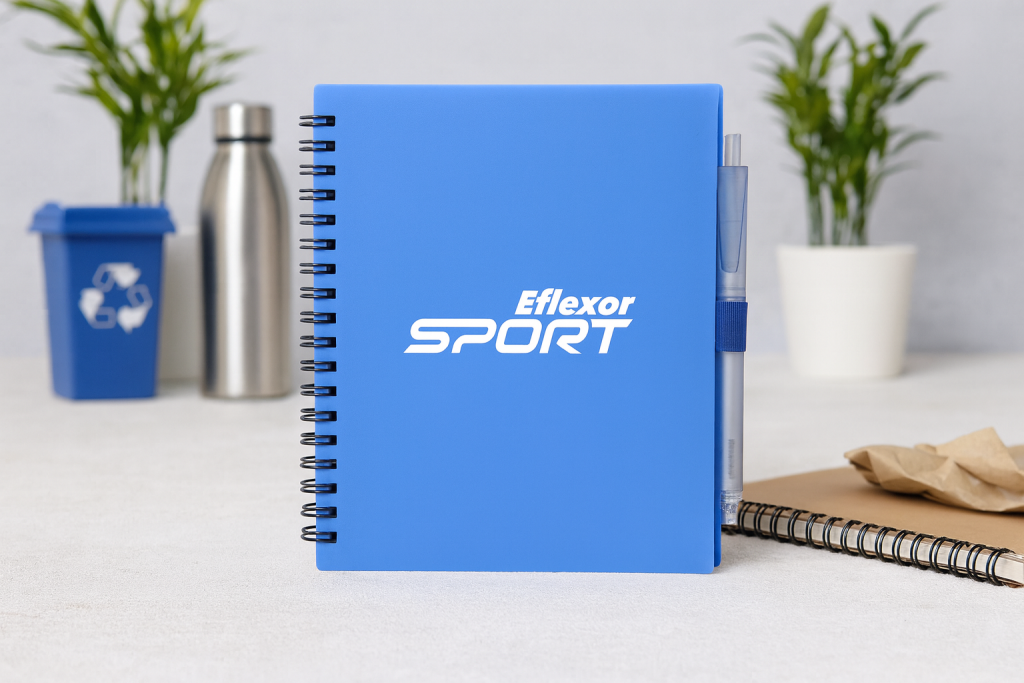
This digital saturation creates a powerful paradox: as digital impressions become more fleeting and intermediated, the value of a physical, tangible interaction skyrockets. A search result disappears the moment a user scrolls or closes a tab. However, a high-quality physical item like a branded notebook or a durable tumbler provides a level of permanence that digital channels simply cannot replicate.
In an era where digital content is increasingly summarized and commoditized by AI, physical touchpoints offer brand presence. They don't require a click to be seen, and they don't disappear when an algorithm updates.
Becoming a Destination Brand
To survive the enshittification of search, brands must become platform-agnostic. The goal is no longer just to win a generic keyword; it is to become a trusted destination. By leveraging physical products to build genuine brand recall, companies can drive direct brand searches, bypassing the digital gatekeepers entirely. In a world of zero-clicks, the most valuable real estate isn't on a screen. It's the item sitting on your customer's desk.